
John L. Lewis
(1880–1969)
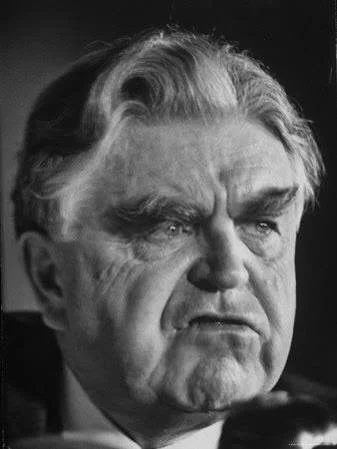
John Llewellyn Lewis was born in 1880 in Lucas, Iowa, to Welsh immigrant parents. His father was a coal miner, and Lewis went into the mines as a teenager. He rose through the United Mine Workers of America (UMWA), worked as an organizer for Samuel Gompers’ AFL, and became president of the UMWA in 1920. He would lead the union for 40 years. With his thick eyebrows, booming voice, and dramatic speeches, Lewis became one of the most recognizable and feared figures in American public life.
Lewis’s union nearly collapsed during the 1920s as coal companies cut wages and broke strikes. When Franklin Roosevelt’s New Deal passed laws protecting workers’ right to organize in 1933, Lewis seized the opening. He sent organizers into the coalfields with the message that the president wanted miners to join the union, and UMWA membership exploded. Lewis believed the AFL’s craft unions could never organize the millions of workers in steel, auto, rubber, and other mass-production industries. In 1935 he led the creation of the Committee for Industrial Organization, which became the Congress of Industrial Organizations (CIO), uniting workers in an entire industry regardless of job title. Within two years, the CIO won historic victories, including the Flint sit-down strike against General Motors and a contract with U.S. Steel, the most powerful corporation in the country.
Lewis understood that labor needed political muscle to protect its gains. In 1936 the Mine Workers gave hundreds of thousands of dollars to Roosevelt’s reelection campaign, making labor a major force in national politics for the first time. But Lewis also insisted on labor’s independence. When he broke with Roosevelt in 1940, he endorsed the Republican candidate and resigned as CIO president after Roosevelt won. During World War II, he led coal strikes despite enormous public criticism. After the war, he won a landmark health and retirement fund for miners, paid for by a royalty on every ton of coal mined, setting a model for union benefit plans across the country.
Lewis’s legacy is mixed. He built enormous power for workers but ran the Mine Workers with an iron hand, limiting internal democracy and leaving the union vulnerable to the corruption that followed his retirement in 1960. He died in 1969. For organizers today, Lewis offers powerful lessons. Political openings must be seized quickly, organizing whole industries builds far more power than organizing one craft at a time, and labor’s political support should be earned by politicians, not taken for granted. His story also reminds us that a union’s strength depends on members having a real voice in it.