
Sidney Hillman
(1887–1946)
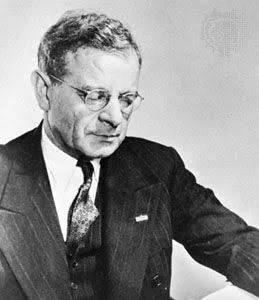
Sidney Hillman was born in 1887 in a Jewish community in Lithuania, then part of the Russian Empire. He studied to become a rabbi but was drawn into the underground labor movement instead, and he was jailed for his role in the 1905 revolution against the czar. In 1907 he emigrated to Chicago and found work as a cutter at Hart Schaffner & Marx, one of the country’s largest clothing manufacturers. In 1910, a walkout by young women garment workers, led by Bessie Abramowitz, who later became his wife, grew into a massive strike. Hillman emerged as a leader, and the settlement created one of the first systems in the industry for resolving workers’ grievances.
In 1914 Hillman founded the Amalgamated Clothing Workers of America and led it for the rest of his life. He believed a union should improve every part of workers’ lives, not just their paychecks. Under his leadership, the Amalgamated won the 40-hour week, built cooperative housing in New York, opened union-owned banks, and created unemployment insurance for its members years before the government did. In 1935 Hillman joined John L. Lewis in founding the CIO, helping bring millions of industrial workers into the labor movement. He also became one of Franklin Roosevelt’s closest labor advisors, pushing for the Fair Labor Standards Act of 1938, which established the federal minimum wage and the 40-hour workweek.
Hillman’s most lasting contribution came in 1943. Congress passed the Smith-Connally Act, which banned unions from using their treasury funds in federal elections. Hillman responded by creating the CIO Political Action Committee, the first PAC in American history. Funded by voluntary contributions from members, CIO-PAC registered voters, knocked on doors, distributed literature, and turned out workers on a scale never seen before. It played a major role in Roosevelt’s 1944 reelection, and Hillman became so influential that the phrase “Clear it with Sidney” became a symbol of labor’s power inside the Democratic Party. Critics on both the right and left attacked him, some for giving labor too much influence and others for tying the movement too closely to one party.
Hillman died in 1946, but the model he built still defines labor politics today. Nearly every union in the country now runs political programs based on the PAC structure he invented. For organizers, Hillman’s life offers clear lessons. When laws are written to weaken workers, unions must adapt and find new ways to build power. Political strength comes from members who are organized, registered, and mobilized, not just from money. A union can also be more than a bargaining unit; it can be a force that improves workers’ housing, finances, and security.